
Why is uv so freaking fast?
Architectural decisions behind uv, hard problems team Astral solved, and so much more

If you’ve used python for any amount of time, you know the standard ritual.
Start a new project, and the usual dance begins: python -m venv venv, then source.venv/bin/activate, followed by a pip install that takes long enough that you can make a cup of coffee and come back. You juggle pip, venv, pip-tools, and maybe even pyenv just to get a project running. It works, but it’s always felt a bit….clunky.
Then, in early 2024, a tool called uv arrived from Astral, the same team behind the super-fast linter, Ruff. The selling point was it’s speed claims. Being 10x to 100x faster than pip.
But uv isn’t just about speed. It is a hard engineering problem solved elegantly. Today we take a look deeper into the clever engineering that makes it all possible.
How is uv so fast?
Think of it as an aggregation of decisions that make it blazing fast. Let’s break down the 3 big ones:
1. It’s written in Rust (duh!)
Yes, it’s written in Rust. And we all know that Rust is fast. For beginners, here is why:
Think of it this way: Python is an interpreted language. When you run a tool like pip, your computer has to run the python interpreter, which then reads and executes the pip code line by line. It’s like a translator reading a book out loud.
uv, being written in Rust, is compiled directly into machine instructions. It’s single, self-contained binary file. There’s no translator needed; the instructions are already in the computer’s native language.
This also lets uv sidestep something called the Global Interpreter Lock(GIL). In simple terms, the GIL is a rule in python that generally only allows one thread to execute at a time. Rust has no such rule, so uv can use all of your processor’s cores to download and install packages in parallel.
2. Global cache: A library of packages
This is arguable uv’s most brilliant innovation. May seem obvious in hindsight but it’s brilliant.
When you use pip, it copies all of a package’s files into your project’s .venv folder. Ten projects using pandas means ten full copies on your disk.
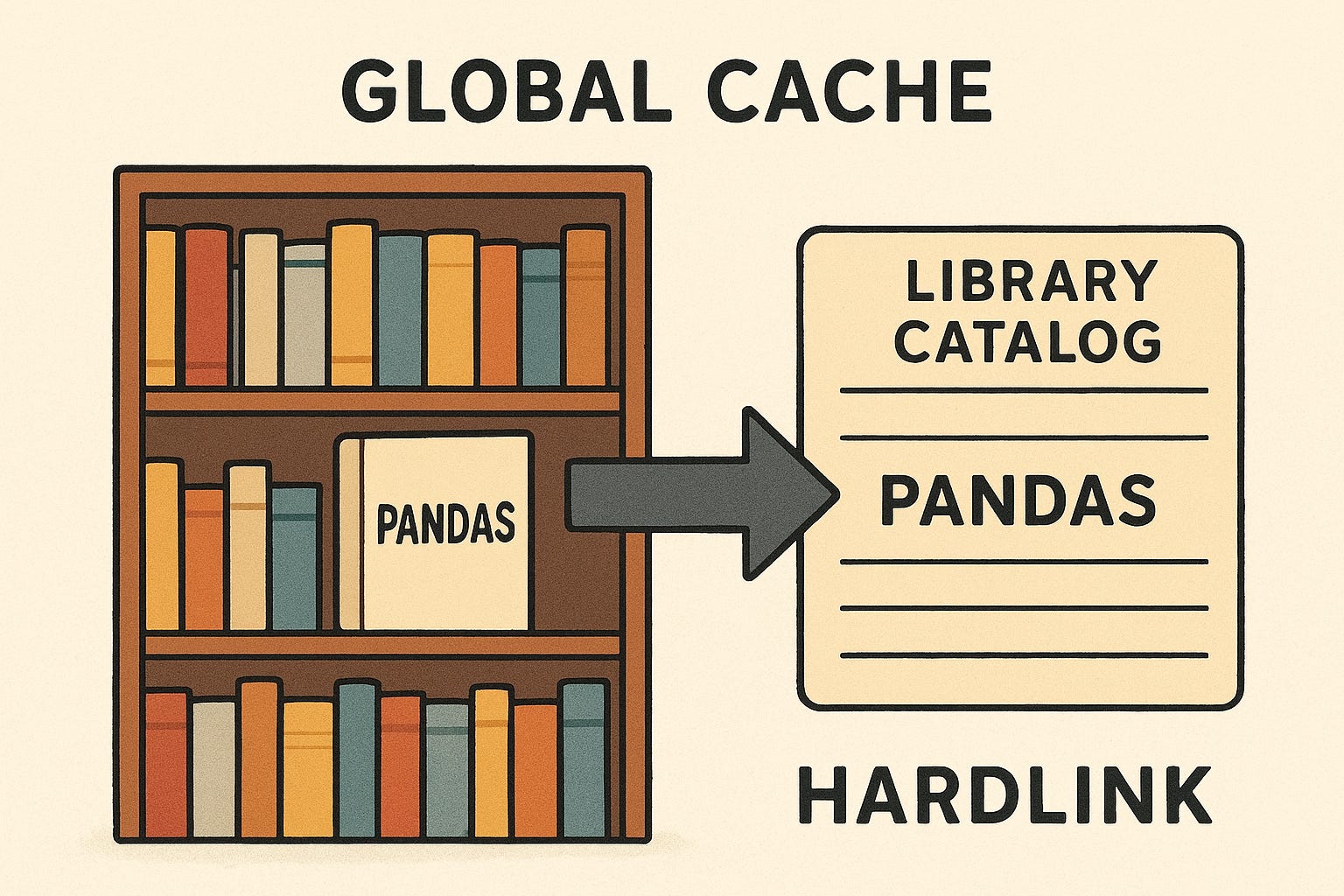
uv is smarter. The first time it downloads a package,it unpacks it into a central, global cache. A single “library” of packages on your computer. When you create a new environment, uv doesn’t copy the files. Instead, it uses a filesystem trick called hardlinks or Copy-on-Write(CoW).
Let’s understand it with an analogy:
Imagine global cache is a physical library, and pandas is a book on the shelf. A hardlink is like creating a new card in the library’s catalog that points to the exact same book. You can have hundreds of “copies” in your projects, but they all point to the one true book in the library.
This is why creating a new environment with a “warm” cache is nearly instantaneous. It’s just creating pointers, not copying gigabytes of data.
3. Brains of the operations: Dependency solver
Dependency hell — every python developer runs into it eventually. This happens because, unlike many other languages, Python’s runtime doesn’t allow multiple versions of the same package to be installed at once. If package-A needs Pydantic v1 and package-B needs Pydantic v2, you have an unsolvable problem.
This is where uv’s resolver, PubGrub, comes in:
At its core, PubGrub is a type of Boolean Satisfiability solver (SAT solver). A SAT Solver is a logic puzzle solver.
Imagine you’re trying to figure out a schedule for meetings. You have rules like:
- “Ram can’t meet on Fridays”
- “Shyam needs to meet after Carol”
- “Project update must be before 3PM”
A SAT Solver is a tool that can look at all your rules and tell you if a valid schedule exists.
This is an incredibly hard problem (NP-Hard, for the CS folks), butuvsolves this efficiently (tries it’s best). Though there is no guarantee it will solve in a reasonable amount of time in all theoretical casesHow it works?
The resolver starts with your direct dependencies and begins making decisions, picking the latest compatible version of a package and adding its requirements to the pool of rules. It continues the process, building a solution step-by-step.Intelligent backtracking
The real magic is when it hits a wall. Let’s say it books Ram for a meeting that breaks another rule. A basic solver may start from scratch but PubGrub is smarter.
It uses a technique called Conflict-Driven Clause Learning(CDCL). It learns from the conflict. It adds makes new rules and backtracks intelligently, knowing not to make that specific mistake again.
This is what allowsuvto give you a clear, human-readable error.
Now that we know the “HOW”. Let’s unpack the hard problems Team Astral solved.
The “Hard Problems” uv solves under the hood
Beyond the basics, uv tackles some very difficult parts of python packaging that lead to huge performance gains and a better overall user experience
1. Universal lock file
Python packages have “markers” that make dependencies conditional (e.g., install colorama only on Windows). This makes creating a single lock file that works for everyone a huge challenge.
The solution: Forking the graph.
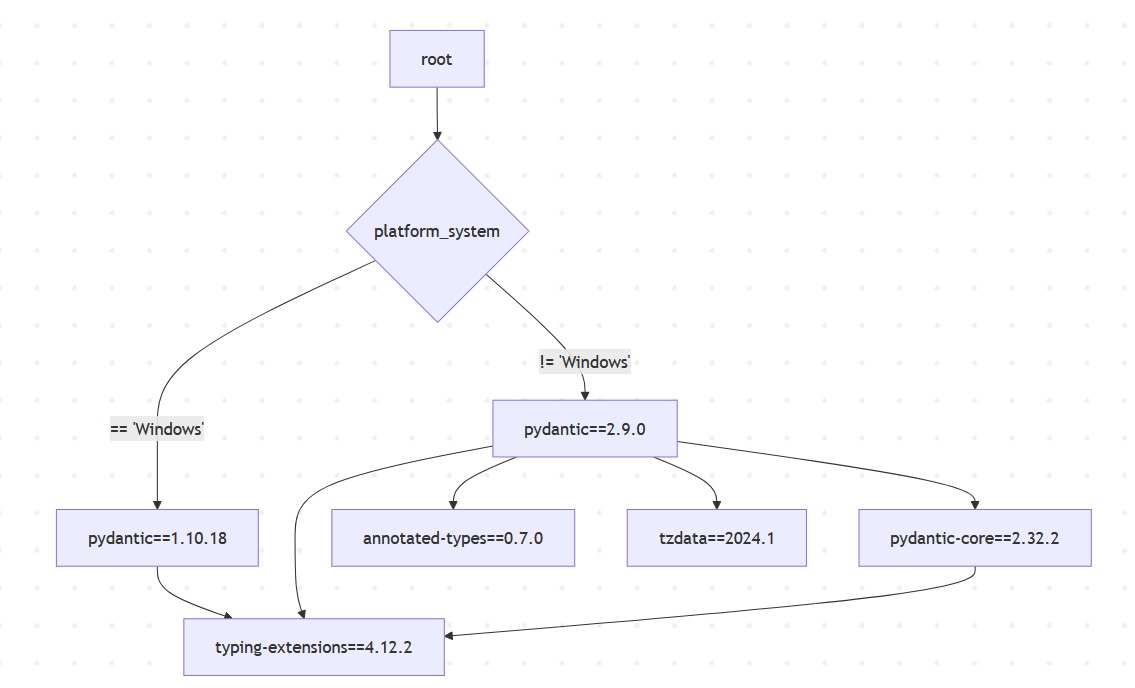
When uv encounters a platform-specific dependency, it “forks” the graph, creating a seprate path for Windows and another for non-Windows systems. It solves each path independently and merges them back together.
The final uv.lock file contains all of these paths. So, when you run uv sync, it simply follows the path that matches your current system.
2. Low-level Optimizations
These are the kinds of engineering choices that separate a good tool from a great one.
Efficient version parsing
Python version strings can be complex (1.2.3.rc1, 2024.5.0). Comparing them can be slow if you have to parse them every time. uv uses a clever trick: for over 90% of versions on PyPI, it can pack the entire version into a single 64-bit integer(u64)
The 64 bits are divided up to store different parts of the version. For example, the first two bytes might store the first number, the next three bytes store the next three numbers, and the final bytes tore pre-release tags like rc1.
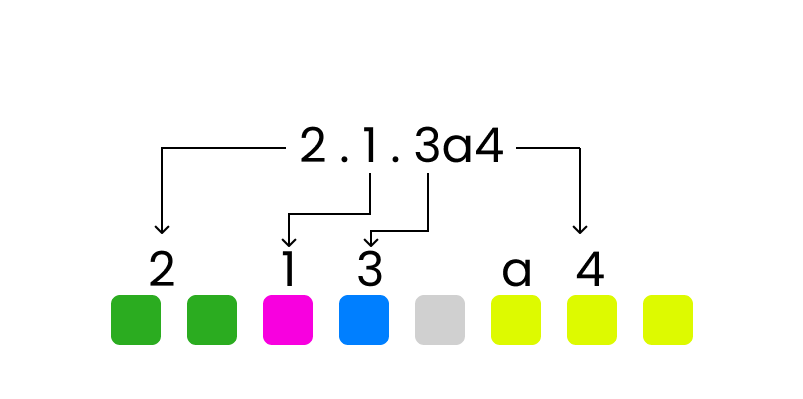
Think of comparing dates, it’s much faster to compare two time stamps (like 1724283600) than it is to compare three separate numbers for year, month, and day. uv does the same for package versions. This avoids complex string operations and allows for a single, lightining-fast machine instruction (memcmp) to compare two versions, leading to a 3-4x speedup in resolutions.
It has its limitations but it’s fast and gets the job done.
Partial wheel downloads
A python ‘wheel’ file is just a zip archive. Some, like PyTorch, can be gigabytes in size. To figure out a package’s dependencies, a tool needs to read its metadata file, which is inside that zip. The naive approach is to download the entire zip file just to read a few kilobytes of text. Inefficient and time consuming.
uv is much smarter. It uses a trick called a HTTP “range request.” Think of a zip file like a book: the "central directory" (its table of contents) is at the very end. uv first asks the server for just that last page. From that tiny download, it learns the exact location of the file it needs inside the archive. Then, it makes a second, precise request to grab only that specific piece.
This two-step process saves a massive amount of time and bandwidth compared to fetching the entire package.
Disposable environments
When things are way faster they really change the user’s relationship to the tool.
~ Charlie Marsh
These technical innovations make things faster. And change how you work.
Virtual environments used to be hard and hence feel precious. With uv, they become cheap and easy to replace.
Got a weird bug? Don’t spend time fixing your environment. Just delete it and run uv sync. In seconds you have a perfectly clean, reproducible environment built from your lock file.
More than speed, it’s elegant engineering
The incredible speed of uv is what gets your attention, but the thoughtful engineering is what makes you admire it. By building from scratch in Rust, innovating at the filesystel level, and employinga sophisticated SAT solved, uv addresses decades of friction in the Python ecosystem.
If you haven’ t tried it yet, give it a spin on your next project. You won’t go back.
If you want to hear it from the founder of Astral himself, watch this video for a full breakdown.
Resources
For a more hands-on setup of uv, follow this video.